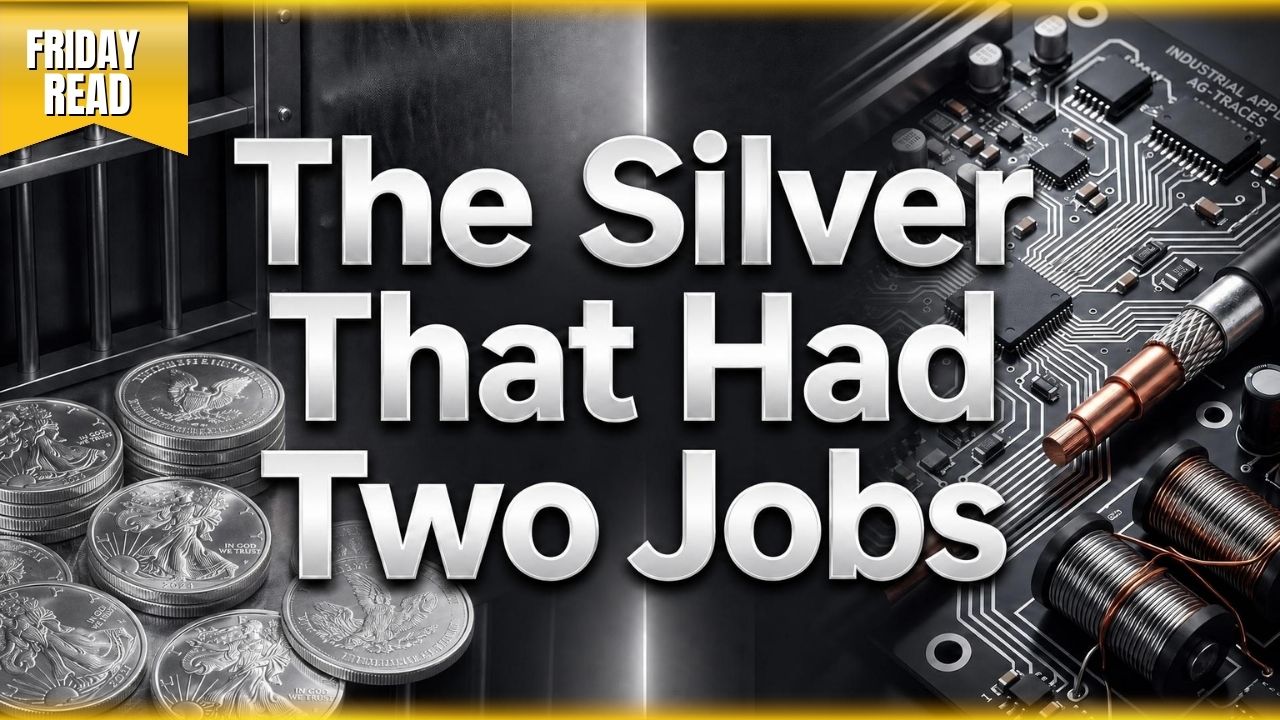
In August 1942, Colonel Kenneth Nichols went to the US Treasury to ask if he could borrow 6,000 tons of silver. There was a war on, copper was scarce, and the Manhattan Project needed enormous electrical conductors for the equipment being built at Oak Ridge, Tennessee. Silver would do the job, provided he could get his hands on enough of it. The Treasury wanted the request expressed in troy ounces, which was something of a frustration for Nichols, who was rather more interested in getting the metal. Even with an atomic bomb to build, there were standards to maintain.
The project eventually borrowed 14,700 tons, turning bullion into components for the giant electromagnets used to separate uranium isotopes. The last of it was returned in 1970, having spent years doing a job few people would associate with a Treasury reserve.
Winter Is Coming: What The IMF Just Told Investors
I rather like this story because it captures something that gets lost whenever silver is described as gold’s cheaper relative. The Treasury saw stored wealth, the engineers saw a particularly useful material, and both were right. They were looking at the same silver from opposite ends of its working life.
Writing in MoneyWeek this week, Charlie Morris makes the case for understanding silver through gold. It is a sensible starting point particularly when people so often ask us if they should buy silver or gold, or assess the price according to where the gold:silver ratio is. When enthusiasm for precious metals takes hold, silver can respond with considerably more enthusiasm of its own, although anyone who has held it through a sharp correction will know how readily that works in reverse.
A smaller price per ounce should never be confused with a smaller capacity to lose money. Add in the manufacturers, who buy silver for its physical properties and have little interest in an investor’s views on government debt, and this brings in more things to consider. A weakening economy can reduce factory demand just as it gives savers another reason to feel nervous about their money.
Then there is the question of where the silver happens to be. This week’s Goldman Sachs research, reproduced in the GoldFix briefing, is particularly interesting on that point.
The bank argues that uncertainty over American tariffs has encouraged traders to move metals, including silver, into the United States ahead of possible duties. You can see their logic here: if there might soon be a cost attached to bringing metal into the country, getting it there beforehand feels like the sensible thing to do. Multiply that decision across enough traders and stock begins accumulating in one place, which of course means leaving less immediately available elsewhere, without any change in the amount of metal that exists. Ultimately of course, the tariff itself need never arrive!
Being told there is plenty of silver globally is therefore only so helpful. Anyone who has waited in the rain for a taxi, while being assured there are dozens over by the station, will understand why.
Goldman describes how silver drawn towards America left London more exposed when investment demand subsequently increased, although its research also acknowledges that the resulting price incentives brought some metal back.
What does that mean though, for the market and investors? Silver can move again when the economics justify it, it’s not as though a bar entering an American warehouse has vanished from the earth. What has changed is the price, and perhaps the time required to get it to the next buyer. With less stock readily offered in the place where demand appears, even relatively modest buying can force a substantial adjustment.
But what about the stuff in the ground? Well, as has long been the case in the silver market, mining offers no immediate solution. Much of the world’s silver is a by-product of extracting other metals, which means decisions about increasing output depend on the economics of copper, lead, zinc and gold as well. Excitement in the silver market does not, on its own, justify expanding a copper mine. This is not a new problem.
Buyers adapt too, of course, and this is where some of the more exuberant silver arguments come unstuck. As Jan Skoyles has covered previously on GoldCore TV, manufacturers use less, redesign products or substitute other materials where they can; solar technology already demonstrates why more installations need not require proportionately more silver. Higher prices encourage recycling and persuade existing holders to sell. Obviously these responses take different amounts of time, use different supply routes, but they belong in the argument just as much as the constraints on supply.
For someone thinking about wealth over years, silver’s appeal comes with all of these complications attached. Its monetary history gives people a reason to hold it, its usefulness gives industry a reason to buy it, and neither group can assume that supply will expand promptly to accommodate them. Trade policy adds another uncertainty over who can obtain what, and where. That leaves room for sharp price movements in either direction, with very little regard for the patience of the person holding the investment.
I find the competition for those available ounces more interesting than calculations about silver returning to a centuries-old ratio against gold. In 1942, the Treasury could lend its silver to the engineers and wait for it to come back. Today’s investors and manufacturers have no such convenient arrangement, so when both want the same metal, the price has to negotiate between them.
Editorial source notes
Historical opening: Y-12 National Security Complex, “14,700 tons of silver at Y-12”, drawing on Nichols’s account. https://www.y12.doe.gov/sites/default/files/assets/document/07-10-11.pdf. Historical quantities are retained in the source’s US tons, not converted to metric tonnes. The Treasury exchange is paraphrased, not presented as a verbatim quotation.
Charlie Morris: MoneyWeek. The draft draws on its gold/silver investment relationship without adopting its historical-ratio targets, snapshot prices or fixed beta. Beta is not itself a direct measure of relative volatility.
Goldman Sachs: 23 September 2026 research reproduced in the supplied GoldFix briefing, “Copper, Silver, PGMs: Tariff Uncertainty Likely to Persist; Tariff Risk Builds Inventories”.
Supply and industrial adaptation: Silver Institute, 10 February 2026 outlook. Used for by-product supply and solar thrifting/substitution, not its subsequently revised numerical forecasts. https://silverinstitute.org/global-silver-investment-to-remain-strong-in-2026-against-the-backdrop-of-a-sixth-consecutive-annual-market-deficit/
Buy Gold Coins

Buy gold coins and bars and store them in the safest vaults in Switzerland, London or Singapore with GoldCore.
Learn why Switzerland remains a safe-haven jurisdiction for owning precious metals. Access Our Most Popular Guide, the Essential Guide to Storing Gold in Switzerland here.
Receive Our Award Winning Market Updates In Your Inbox – Sign Up Here