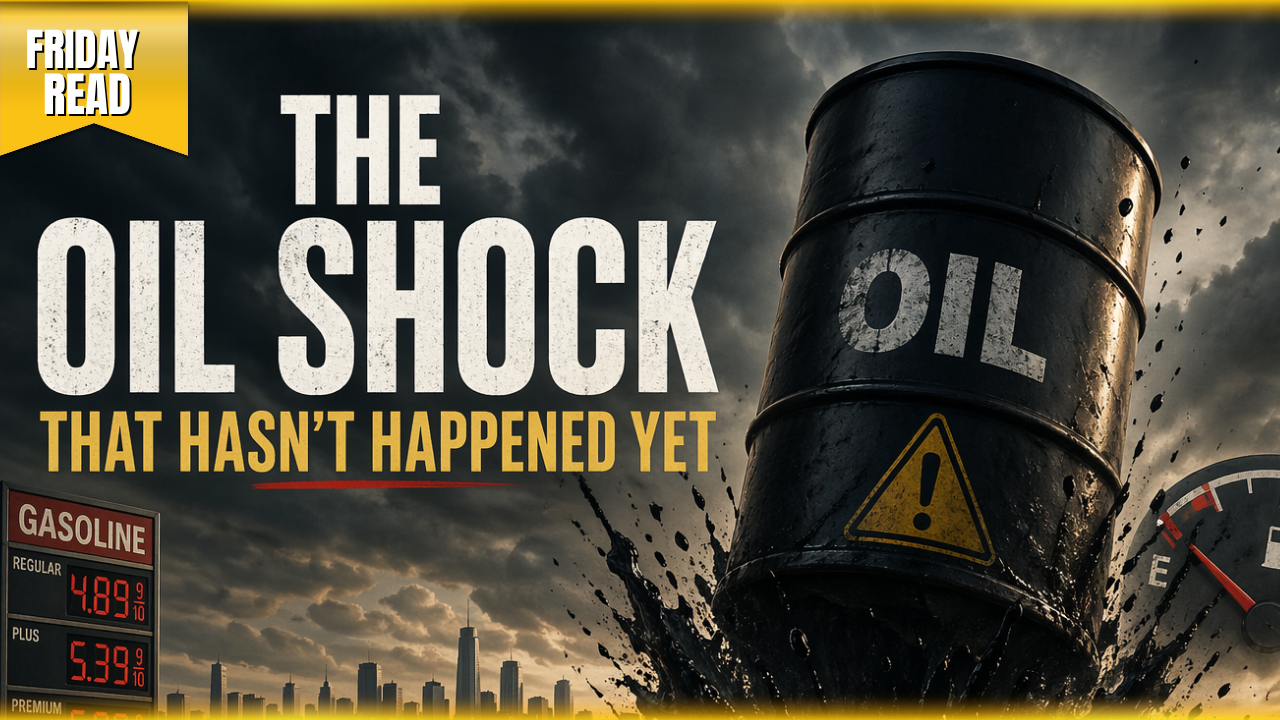
In the desert, a mirage convinces you relief is just ahead. The horizon bends, the heat makes the air appear to shimmer, and what looks like water turns out to be nothing more than heat and distance playing a trick on the eye.
This metaphor came to mind again this week, as I found myself reflecting on just how little, on the surface at least, has changed. The oil market remains under severe strain, the Strait of Hormuz remains deeply compromised, and yet markets, governments, and their citizens continue to behave as though the disruption is manageable, even temporary.
Much of the world’s energy supply still depends on that same narrow passage, and yet the scale of disruption has not translated into the kind of shock many might have expected. Prices are elevated, certainly, but not extreme. Supply is tighter, but it isn’t absent. The system appears, at a glance, to be holding together.
But appearances, as ever, can be deceptive.
The market is still being sustained by cargoes arranged before the crisis fully took hold, by supply chains that have yet to feel the full strain of what is now unfolding. Oil that was bought, shipped, and contracted under a very different set of assumptions is only now arriving at its destination. As those buffers are gradually exhausted, the reassuring image begins to dissolve.
The Question Every Gold & Silver Investor
Gets Wrong Right Now
For now, however, most households and businesses across Europe and the United States have yet to experience anything resembling a true oil shock. Petrol remains available, flights continue to depart, and while costs have risen, daily life has not been meaningfully interrupted. For many, the crisis remains something read about rather than lived through. It is something happening elsewhere.
That apparent calm should not be mistaken for resilience. It is, rather, a reflection of timing.
Oil does not behave like financial assets that reprice instantly. It is a tangible commodity that moves through a physical system of ships, contracts, and infrastructure, and that system introduces an unavoidable lag. Disruptions occur quickly, often suddenly, but their consequences tend to arrive more slowly, only becoming fully visible once the existing supply chain has run its course.
What is being consumed today was, in many cases, secured weeks ago. Tankers that left port before the crisis intensified are only now reaching their intended destinations. Their arrival softens the immediate impact and reinforces the impression that markets are coping. In reality, what is being drawn down is the final layer of pre-crisis supply.
As we are all now well aware, the Strait of Hormuz sits at the centre of this story. For decades, it has functioned as one of the principal conduits of global energy, linking Gulf producers to consumers across continents. When a route of that importance is disrupted, the effects cannot be easily redirected or replaced. The loss is not marginal, nor is it something that can be offset simply by increasing supply elsewhere. It represents a structural constraint within a system that has been built on the assumption of uninterrupted flow.
By most estimates, a meaningful portion of global supply has effectively been removed from circulation, at least temporarily. The scale invites comparison with previous crises, though the dynamics are very different. Where past disruptions have often been demand-driven, what we are witnessing here is a persistent demand confronting an impaired ability to supply.
And yet, if one were to look only at benchmark prices, the situation might still appear manageable. At the time of writing, those prices suggest a market under pressure, but not one in outright distress. It is a signal that invites a degree of complacency.
The more telling indicators, however, lie elsewhere. In the physical market, where cargoes are actually bought and delivered, the cost of securing immediate supply has become far more volatile. Premiums for prompt delivery have widened significantly, varying not just by region, but by route, timing, and even individual shipment. The gap between these real-world transactions and the benchmark prices that dominate headlines suggests that the strain on the system runs deeper than is widely appreciated.
What is perhaps most striking, however, is the growing disconnect between how markets are pricing this disruption and how those closest to the physical system describe it. Among traders, refiners, and shipping participants, there is a far greater degree of concern than is evident in benchmark prices, which continue to suggest a level of stability that few directly involved would recognise. Financial markets appear, for the moment, to be pricing in resolution as a base case, not necessarily because it is the most likely outcome, but because the alternative would require a far more severe and immediate adjustment than many are prepared to contemplate.
This pressure is already reshaping global trade flows. Buyers in Asia, facing the greatest exposure to disrupted Middle Eastern supply, are securing alternative sources with increasing urgency. In doing so, they are drawing heavily on barrels that might otherwise have supplied Europe or North America. The market is not simply adjusting prices; it is reallocating supply based on necessity.
For Western economies, this introduces an uncomfortable reality. The United States may take some reassurance from its own production capacity, but being a major producer does not necessarily confer insulation in a global market where supply moves to where it is most valued. Much of the infrastructure that supports production and distribution is built around established patterns of trade, and those patterns cannot be reconfigured overnight. Europe, with its more limited domestic production, is more exposed still, though this exposure remains, for now, insufficiently appreciated.
The consequence is unlikely to be a sudden and dramatic rupture, but rather a gradual tightening. Shortages, when they emerge, tend not to announce themselves all at once. Instead, the economics begin to shift. Refiners find it increasingly difficult to operate on viable terms. Margins compress, output adjusts, and availability follows.
It is at this point that the broader effects begin to take hold. Diesel underpins logistics, agriculture, and industry. Jet fuel sustains global movement. Gas feeds into power generation and heating. As these inputs become more expensive or less readily available, the effects ripple outward, influencing everything from transport costs to food prices.
In parts of the world more immediately exposed, these pressures are already evident. Across much of developing Asia, the strain has moved beyond theory. Shortages are beginning to emerge, governments are considering or implementing rationing measures, and demand is being curtailed not by choice, but by necessity. These are not distant projections, but early indications of how the system responds when energy becomes constrained.
For policymakers, the choices are not especially attractive. Strategic reserves can provide temporary relief, but they are finite by design. Interventions may ease pressure in the short term, but often at the cost of introducing further distortions. Public finances, already stretched, limit the scope for sustained support.
For many of us, recent crises have been financial in nature, moving quickly through markets and often addressed through monetary measures. What is now unfolding is different. It is rooted in physical constraints, where supply cannot be expanded by policy decision or central bank intervention.
The greater danger lies in the temptation to take comfort from the absence of immediate disruption. Markets continue to function. Goods continue to move. The system, at least superficially, continues to operate.
But it is often in such moments that underlying fragilities are most acute.
Nor is this pattern confined to energy alone. Across other critical markets, similar adjustments are beginning to take shape. In gold, for example, physical flows between major hubs have shifted noticeably in recent months, with large volumes moving in response to geopolitical tension, regulatory uncertainty, and changing trade dynamics. As with oil, the more revealing signals are not always found in headline prices, but in the movement of the underlying commodity itself. In both cases, what is being observed is a system adapting in real time, even as financial markets continue to suggest a degree of calm that may prove misleading.
The oil shock has not yet been fully felt because the system has been sustained by what came before. As that support fades, the present will assert itself more forcefully. Even if the Strait were to reopen tomorrow, the effects of what has already occurred will continue to work their way through the system. Lost flows cannot simply be recovered, and disrupted trade patterns do not immediately revert to their previous state.
What we are witnessing, then, is not the absence of a shock, but its delay.
And delays, in systems of this complexity, rarely make the eventual adjustment easier.
As inventories are drawn down, as supply continues to be redirected, and as the underlying imbalance between demand and availability becomes more difficult to obscure, the strain will become more visible. It may first appear in higher prices, then in tighter availability, and eventually in changes to behaviour that reflect a system operating under constraint.
The mirage, in other words, does not disappear all at once. It fades gradually, until what lies ahead becomes unmistakably clear.
Buy Gold Coins

Buy gold coins and bars and store them in the safest vaults in Switzerland, London or Singapore with GoldCore.
Learn why Switzerland remains a safe-haven jurisdiction for owning precious metals. Access Our Most Popular Guide, the Essential Guide to Storing Gold in Switzerland here.
Receive Our Award Winning Market Updates In Your Inbox – Sign Up Here