For many of our clients and readers, today marks the beginning of a three day weekend as we head into the May Day Bank Holiday, a date observed across much of the world. It carries different meanings depending on where one stands, from pagan celebrations of spring through to International Workers’ Day.
In some countries it is a moment of rest, in others a day of protest. It is not to be confused with the international distress signal, “mayday” (taken from the French ‘m’aider’ which means “help me”), although given the current state of the world, the distinction feels less certain than usual.
At first glance, we appear to be moving through a period framed as renewal. Many Western leaders speak in the language of opportunity and markets continue to behave as though recent disruptions will resolve in due course. There is, as ever in spring, a sense of optimism.
And yet the calm feels uneasy. Particularly in the West, where the absence of immediate disruption feels less like stability and more like a delay in consequence, especially when set against the unresolved closure of the Strait of Hormuz.
Anecdotally, many friends and contemporaries remain focused on near-term concerns such as summer travel plans. This is understandable, but it also highlights how little the broader implications of current events have filtered into everyday thinking.
As we have explored in recent Friday Reads and GoldCoreTV episodes, this is not a crisis that lends itself to simple comparison or resolution. There is no playbook for this, no central bank policy to be renewed and no government bailout to see us through the worst of it.
Deutsche Bank Just Said Gold Is Going To $8,000
Compared to a week ago, oil prices are perhaps beginning to reflect the strain beneath the surface, with Brent crude rising sharply this week and briefly exceeding $126 per barrel. While there may be short-term easing in the oil price, officials acknowledge that a swift resolution to the disruption in the Strait of Hormuz is unlikely and so we expect things to keep ticking up.
This contradiction between visible strain and apparent calm is captured in Fiona Hill’s framework. Writing for Brookings, Hill suggests that rather than moving from order to disorder and then to a new order, we are experiencing all three at once, a single process of reconfiguration.
For decades, the global system operated under broadly accepted rules governing trade, security, and finance, supported by institutions and the stabilising influence of a dominant power. Efficiency was prioritised and interdependence was assumed to be a source of strength.
That system has not collapsed so much as fragmented. States, corporations, and individuals are reshaping rules to serve their own interests, often at the expense of coherence.
The United States, once central to this system, is stepping back from its role as guarantor while redefining economic policy as a strategic tool. At the same time, no single power appears willing or able to replace it. China pursues its own model, and middle powers assert themselves in ways that add to fragmentation.
The result is a world in which multiple actors are rewriting the rules simultaneously, across trade, technology, finance, and security. What appears as disorder may instead be a system adapting without a central coordinating force.
The Strait of Hormuz crisis should be viewed in this context. It is not merely a geopolitical flashpoint, but a stress test of a system built on uninterrupted flow.
Oil moves through physical networks that create delays between disruption and impact. What is being consumed today was secured under pre-crisis conditions, sustaining the illusion of normality. That lag is what makes the current calm so deceptive.
As supply chains adjust, consequences tend to emerge gradually and then all at once. Institutions are already warning of slower growth, higher inflation, and rising poverty should disruption persist. These are not speculative outcomes but mechanical ones that will touch every corner of the globe. This is a time for the history books and crisis management workshops of the future.
Despite this, there remains a belief that the system will revert to its previous state. This reflects the mindset of the old order more than the realities of the current one.
If Hill is correct, we are in a structural transition. The rules governing global interaction are being contested and reshaped without a clear successor. As with any disruption to the status quo, such periods are rarely smooth. History suggests they are marked by overlapping systems and prolonged uncertainty.
This has implications for capital allocation and wealth preservation. Central banks, particularly in emerging markets, are increasing gold holdings not as a short-term trade but as a strategic adjustment to fragmentation.
Gold sits outside the network of liabilities that define modern finance, offering a reserve asset not subject to the same vulnerabilities as currencies or sovereign debt.
Deutsche Bank has outlined a scenario in which increased central bank allocations could drive gold prices significantly higher over time, (potentially to $8,000, they say). The figure itself is less important than what it represents: the imbalance between global financial assets and the limited supply of gold.
If this continues, assets outside the conventional financial system are likely to play a greater role, not as speculative opportunities but as components of resilience.
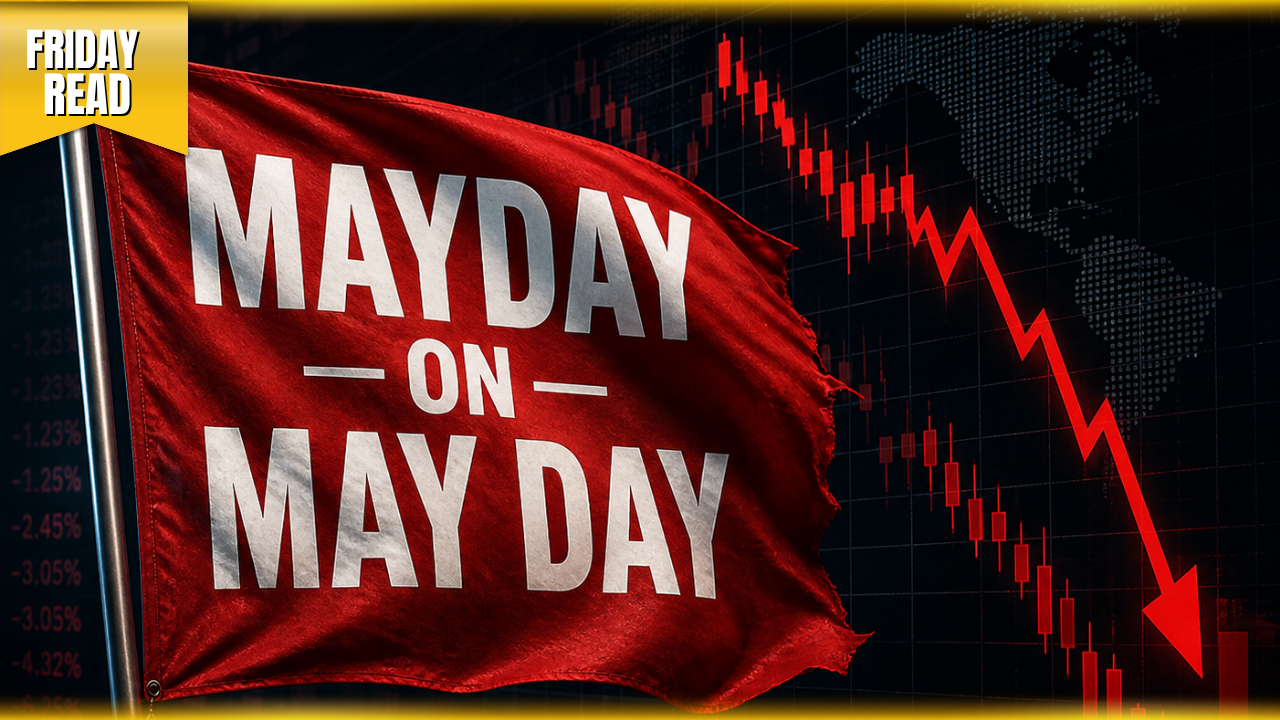
Which brings us back to mayday on May Day, a moment that captures both renewal and distress.
Buy Gold Coins

Buy gold coins and bars and store them in the safest vaults in Switzerland, London or Singapore with GoldCore.
Learn why Switzerland remains a safe-haven jurisdiction for owning precious metals. Access Our Most Popular Guide, the Essential Guide to Storing Gold in Switzerland here.
Receive Our Award Winning Market Updates In Your Inbox – Sign Up Here